Virtual laboratories
3D Virtual Pharmacy Labs
Four laboratories, one complete practical in each. Walk up to the bench, handle the apparatus, make the measurements yourself — and get a report built from what you actually did.
Choose a laboratory
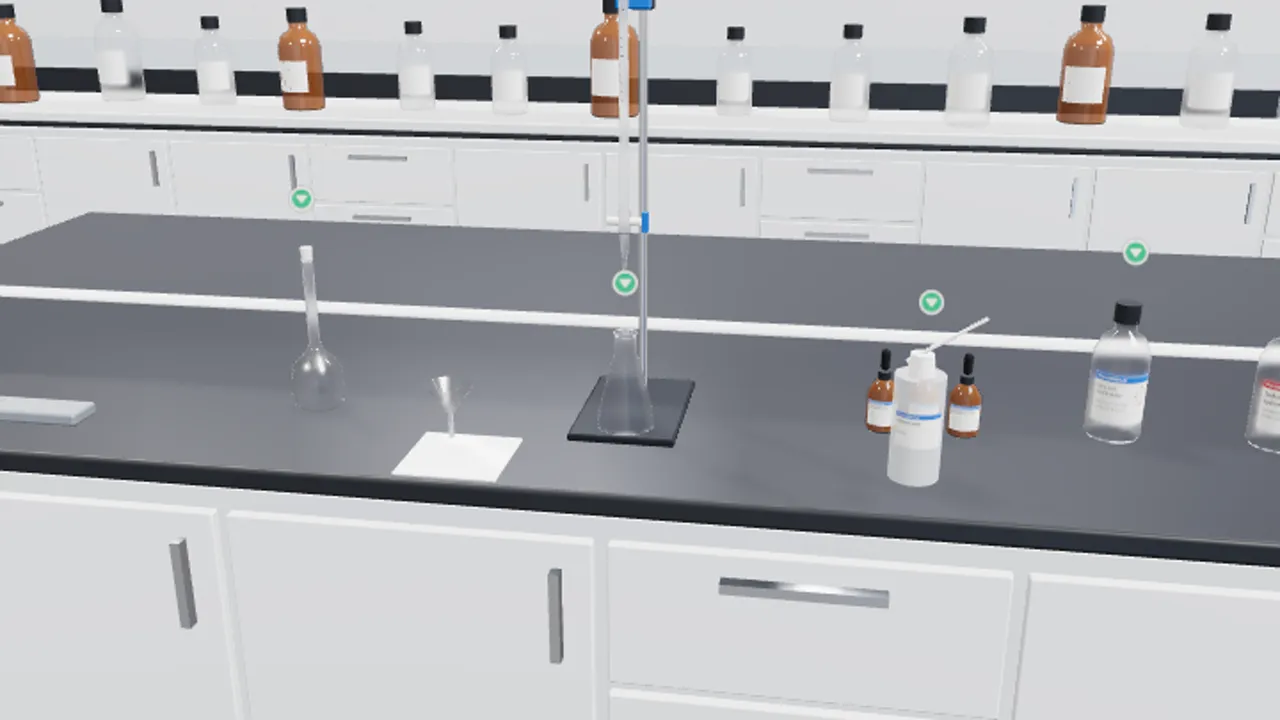 Pharmaceutical Chemistry
 Laboratory
Assay of citric acid by acid–base titration
- Choose apparatus and an indicator suited to a weak acid–strong base titration
- Weigh, dilute and pipette quantitatively
- Read a burette to 0.01 mL and judge a faint permanent end-point
- Calculate an assay with the correct stoichiometry and units
~30 minIntermediateSyllabus source verifiedListed in the UoK Pharm-D practical syllabus (PHC-607 Pharmaceutical Analysis – I, 4th year, 1st semester: “Acid base titration”). The syllabus names no sample — citric acid is our illustrative choice. Not faculty-reviewed.
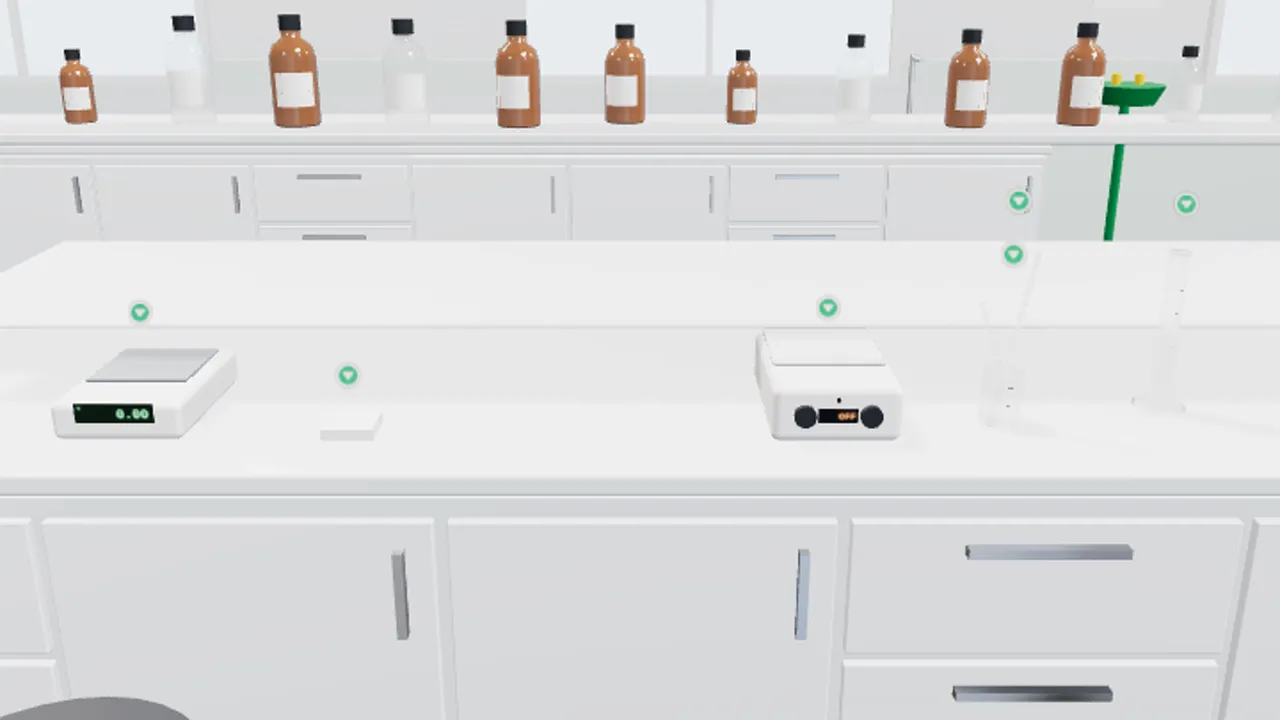 Pharmaceutics
 Laboratory
Preparation and evaluation of Simple Syrup
- Scale a formula to a batch size
- Weigh on a tared top-pan balance within tolerance
- Dissolve sucrose without inverting or caramelising it, and make up to volume at room temperature
- Evaluate appearance, volume and density, and complete a batch record
~25 minIntroductorySyllabus source verifiedListed in the UoK Pharm-D practical syllabus (PHT-402 Pharmaceutical Dosage Forms Lab, 2nd year, 2nd semester: “Preparation of simple syrups”). The formula used here is illustrative (USP proportions). Not faculty-reviewed.
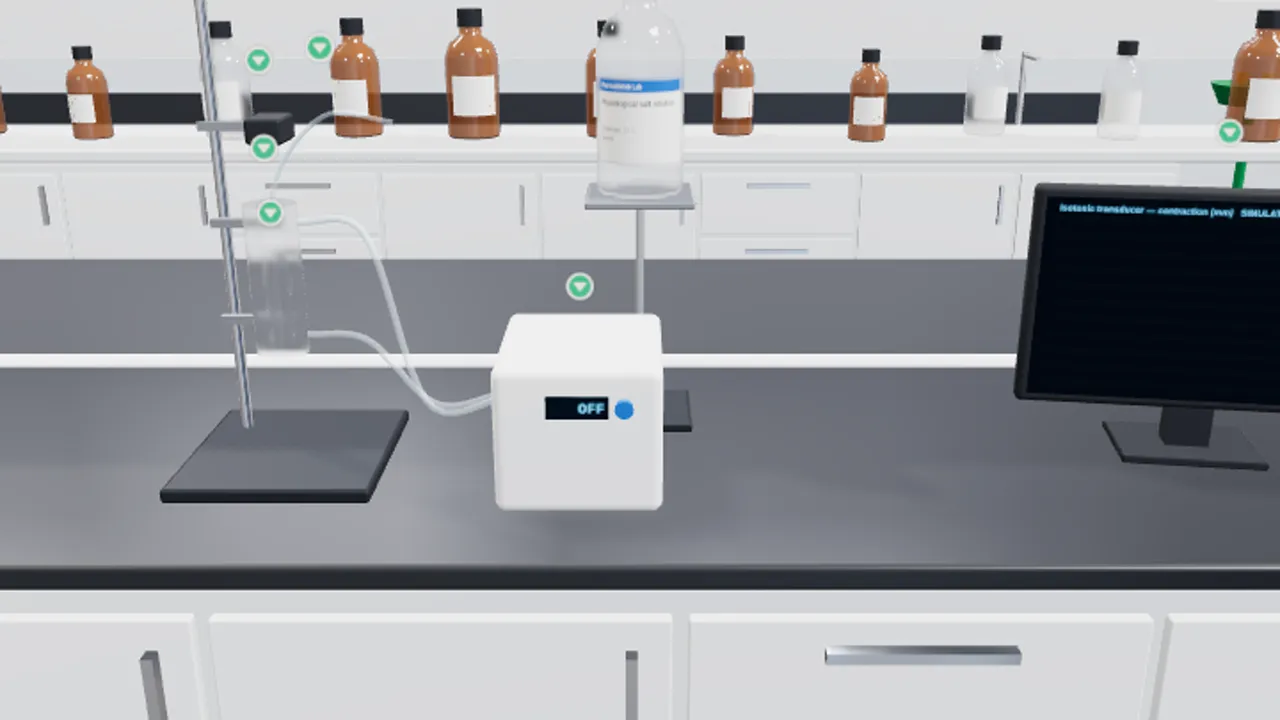 Pharmacology
 Laboratory
Graded dose–response curve (simulated isolated tissue)
- Identify the independent and dependent variables of a dose–response experiment
- Run trials with correct contact time, washout and recovery
- Plot response against concentration and against log concentration
- Estimate Emax and EC50 and explain potency and efficacy
~25 minIntermediateSyllabus source verifiedListed in the UoK Pharm-D practical syllabus (PHL-612 Pharmacology Lab, 4th year, 2nd semester: identifying an unknown concentration of acetylcholine from graded dose–response curves). The syllabus names no tissue; this lab is a simulation with teaching parameters. Not faculty-reviewed.
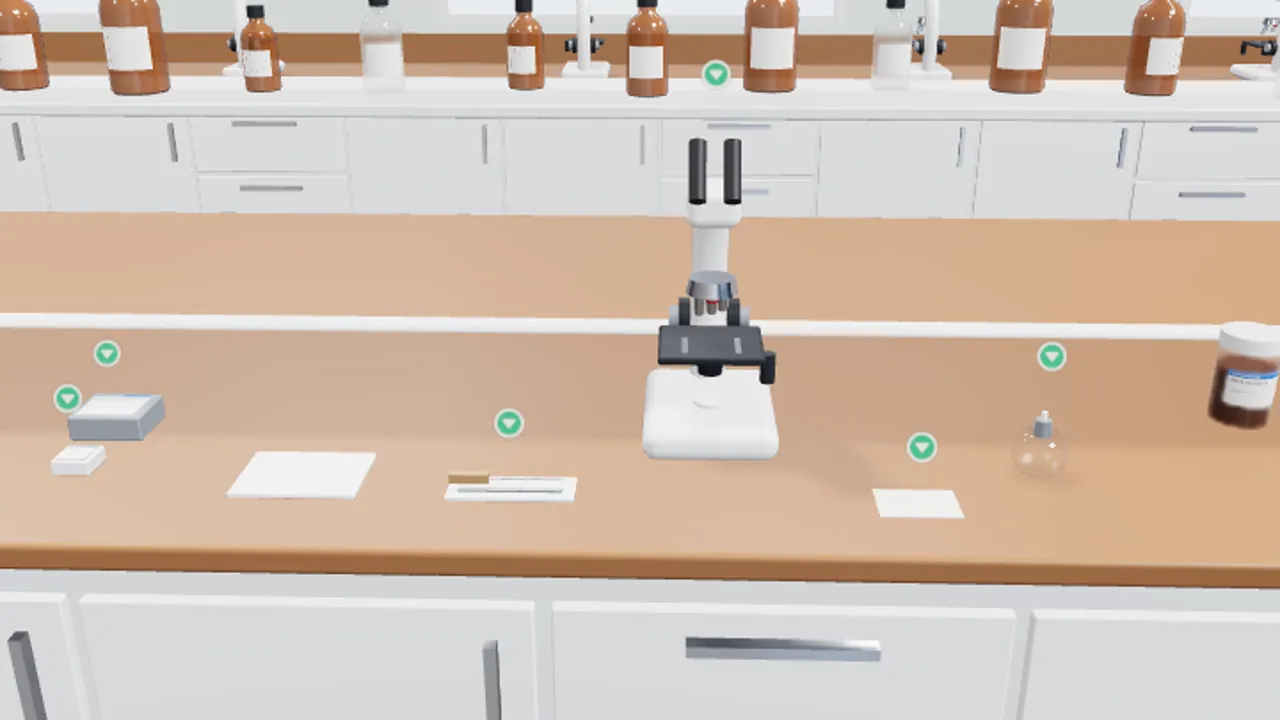 Pharmacognosy
 Laboratory
Microscopical identification of powdered clove
- Prepare a cleared powder mount without air bubbles
- Use coarse and fine focus correctly at low and high power
- Recognise the diagnostic elements of clove powder
- Distinguish genuine clove from clove-stalk and mother-clove adulteration
~25 minIntroductorySyllabus source verifiedListed in the UoK Pharm-D practical syllabus (PHG-411 Pharmacognosy Lab-I, 2nd year, 1st semester: powdered drug examination — flower bud, Eugenia caryophyllus). The microscope view is a schematic illustration. Not faculty-reviewed.
How these labs work
You do the practical. Choose the apparatus, weigh, measure, read the burette or the recorder yourself. Every number in your report comes from your own readings, and mistakes carry through to the result — with an explanation of why.
Walk, or be guided. Explore the room in first person, or let the camera take you to each station. Every action is also a button in the side panel, so the labs work with a keyboard, a screen reader, or on a device without 3D graphics.
Honest about what is simulated. Samples, purities and responses come from documented teaching models and illustrative data — not real patients or animals. Curriculum badges say exactly how far each mapping has been checked; none has yet been reviewed by faculty.
Credits and sources
The rooms, furniture, glassware and instruments are original procedural models built for PharmaWallah. Openly licensed assets used:
- Interior Tiles — Charlotte Baglioni (Poly Haven), CC0 1.0. Not required (CC0); credited as a courtesy.
- Beige Wall 001 — Dimitrios Savva, Rico Cilliers (Poly Haven), CC0 1.0. Not required (CC0); credited as a courtesy.
- Small Empty Room 3 (HDRI) — Sergej Majboroda (Poly Haven), CC0 1.0. Not required (CC0); credited as a courtesy.
- Oil glands of clove powder under light microscope — آية تاج الدين (Wikimedia Commons user), CC BY-SA 4.0. Photo: آية تاج الدين, Wikimedia Commons, CC BY-SA 4.0 — shown with its credit under the image. (Awaiting confirmation by a subject reviewer.)
Curriculum references: University of Karachi Pharm-D practical syllabi (Departments of Pharmaceutical Chemistry, Pharmaceutics, Pharmacology and Pharmacognosy) and the HEC Pharm-D curriculum (2025). Each lab’s briefing quotes the exact entry it maps to.