Unit 1: Introduction to Pharmaceutical Biochemistry
Scope of biochemistry in pharmacy, cell organisation, biomolecules overview, and the molecular logic of living systems.
Prepared by the PharmaWallah student team. Verify results with your textbook or instructor. Report an error · Editorial policy
Unit 1: Introduction to Pharmaceutical Biochemistry
Learning Objectives
- Define biochemistry and explain its scope in pharmacy and health sciences.
- Describe the structural and functional organisation of the cell as the biochemical unit of life.
- Explain the role of water, pH, and buffers in maintaining biochemical homeostasis.
- Understand the significance of pharmaceutical biochemistry in drug action, diagnosis, and patient care.
- Classify biochemical reactions and differentiate between catabolic, anabolic, and amphibolic pathways.
Core Content
1. Introduction to Biochemistry
Biochemistry is the branch of science that explores the chemical processes and substances that occur within living organisms. It bridges chemistry and biology by explaining life at the molecular level, focusing on the structure, function, and interactions of biological macromolecules (proteins, nucleic acids, carbohydrates, lipids).
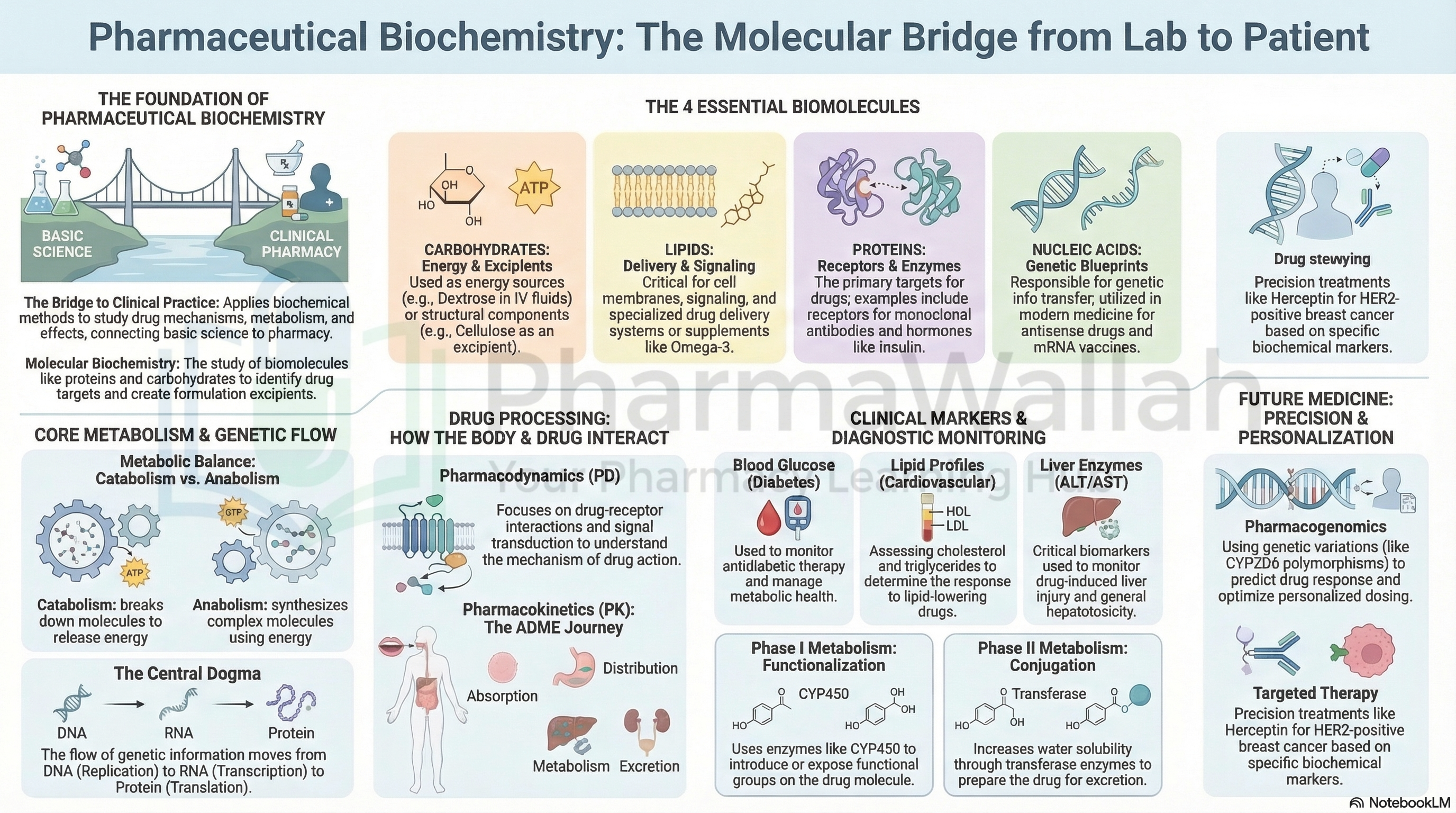
Pharmaceutical Biochemistry applies these principles to drug discovery, action, metabolism, and patient care. It is the bridge between basic biochemistry and clinical pharmacy practice.
Core Areas of Pharmaceutical Biochemistry
| Area | Description | Pharmaceutical Relevance |
|---|---|---|
| Molecular biochemistry | Study of biomolecules | Drug targets, excipients |
| Metabolic biochemistry | Pathways and energy transformations | Drug metabolism, metabolic diseases |
| Clinical biochemistry | Biochemical basis of disease | Diagnostic markers, treatment monitoring |
| Pharmacodynamics | Drug‑receptor interactions, signal transduction | Mechanism of drug action |
| Pharmacokinetics | ADME (Absorption, Distribution, Metabolism, Excretion) | Dosing, bioavailability |
| Toxicological biochemistry | Adverse effects at molecular level | Safety assessment, antidotes |
Cellular Foundation
The cell is the basic unit of life and the site of all biochemical reactions. Key components:
- Cell membrane: Phospholipid bilayer with embedded proteins; controls substance movement.
- Organelles: Mitochondria (energy production), nucleus (genetic information), endoplasmic reticulum (protein/lipid synthesis).
- Cytosol: Aqueous environment for many metabolic pathways.
Hierarchy of Biochemical Organisation
| Level | Description | Example |
|---|---|---|
| Biomolecules | Simple organic molecules | Glucose, amino acids |
| Macromolecules | Polymers of biomolecules | Starch, proteins, DNA |
| Supramolecular structures | Assemblies of macromolecules | Cell membrane, ribosomes |
| Organelles | Functional units within cells | Mitochondria, nucleus |
| Cells | Basic unit of life | Hepatocyte, neuron |
2. Basic Physicochemical Principles
Water: The Medium of Life
Water’s polarity, high heat capacity, and ability to form hydrogen bonds make it the ideal solvent for biological reactions.
- Hydrophilic: Water‑loving molecules (dissolve easily).
- Hydrophobic: Water‑fearing molecules (do not dissolve).
- Amphipathic: Have both hydrophilic and hydrophobic regions (e.g., phospholipids).
Acids, Bases, and pH
- Acids: Donate protons (H⁺).
- Bases: Accept protons (H⁺).
- pH Scale: Measures hydrogen ion concentration:
pH = −log[H⁺]. - Normal blood pH: 7.35–7.45 (tightly regulated).
Buffer Systems
Buffers resist changes in pH when small amounts of acid or base are added. Important biological buffers:
| Buffer System | Location | Function |
|---|---|---|
| Bicarbonate (HCO₃⁻/H₂CO₃) | Blood plasma | Primary extracellular buffer |
| Phosphate (HPO₄²⁻/H₂PO₄⁻) | Intracellular fluid, kidneys | Major intracellular buffer |
| Protein (e.g., haemoglobin) | Blood, cells | Amino acid side chains act as buffers |
Henderson‑Hasselbalch Equation:
pH = pKa + log([A⁻]/[HA])
This relates pH, acid dissociation constant (pKa), and the ratio of conjugate base to acid.
3. Role of Pharmaceutical Biochemistry in the Health Profession
Biochemistry is fundamental to every aspect of pharmacy practice.
3.1 Drug Discovery and Development
- Target identification: Enzymes, receptors, transporters involved in disease.
- Lead optimisation: Structure‑activity relationships (SAR) guided by biochemical assays.
- Preclinical testing: ADME and toxicity studies at molecular level.
3.2 Understanding Drug Action
- Enzyme inhibitors: Statins (HMG‑CoA reductase), NSAIDs (COX enzymes).
- Receptor agonists/antagonists: β‑blockers, antihistamines.
- Ion channel modulators: Calcium channel blockers.
3.3 Drug Metabolism and Pharmacokinetics
- Phase I reactions: Oxidation, reduction, hydrolysis – mainly by CYP450 enzymes.
- Phase II reactions: Conjugation (glucuronidation, sulfation, acetylation) – increase water solubility.
- Pharmacogenomics: Genetic variations affecting drug response (e.g., CYP2D6 and codeine).
3.4 Clinical Biochemistry and Therapeutic Monitoring
| Biomarker | Condition | Pharmaceutical Relevance |
|---|---|---|
| Blood glucose | Diabetes | Monitor antidiabetic therapy |
| Lipid profile | Dyslipidemia | Response to lipid‑lowering drugs |
| Liver enzymes (ALT, AST) | Hepatotoxicity | Detect drug‑induced liver injury |
| Creatinine, BUN | Kidney dysfunction | Adjust drug doses |
| Troponin, CK‑MB | Myocardial infarction | Diagnosis and monitoring |
3.5 Formulation and Pharmaceutical Technology
- Biopharmaceutics (solubility, permeability).
- Excipient‑drug interactions.
- Biotechnology products (insulin, monoclonal antibodies).
3.6 Nutrition and Health
- Biochemical functions of vitamins and minerals.
- Nutraceuticals and dietary supplements.
- Parenteral/enteral nutrition.
3.7 Toxicology and Poison Management
- Mechanisms of drug toxicity (reactive metabolites, oxidative stress).
- Antidotes (N‑acetylcysteine for acetaminophen toxicity replenishes glutathione).
3.8 Personalised Medicine
- Biomarkers for drug selection (HER2, EGFR, BRCA).
- Pharmacogenomic testing to optimise therapy.
3.9 Patient Counselling and Education
- Explaining drug action in simple terms.
- Food‑drug interactions (grapefruit juice inhibits CYP3A4; vitamin K antagonises warfarin).
4. Nature of Biochemical Reactions
Classification
| Type | Definition | Energy | Examples |
|---|---|---|---|
| Catabolic | Breakdown of complex molecules into simpler ones | Exergonic (releases energy, often as ATP) | Glycolysis, β‑oxidation, Krebs cycle |
| Anabolic | Synthesis of complex molecules from simpler precursors | Endergonic (consumes ATP) | Gluconeogenesis, protein synthesis, fatty acid synthesis |
| Amphibolic | Pathways serving both catabolic and anabolic functions | – | Citric acid cycle (intermediates used for energy or biosynthesis) |
Key Features of Biochemical Reactions
- Enzyme catalysis: Lower activation energy, increase reaction rate.
- Specificity: Enzymes are highly specific for their substrates.
- Regulation: Gene expression, allosteric control, covalent modification.
- Thermodynamic feasibility: Reactions occur when ΔG is negative; unfavourable reactions coupled to ATP hydrolysis.
Tables Summary
Table 1: Hierarchy of Biochemical Organisation
| Level | Description | Example |
|---|---|---|
| Biomolecules | Simple organic molecules | Glucose, glycine |
| Macromolecules | Polymers | Starch, proteins, DNA |
| Supramolecular structures | Assemblies | Cell membrane, ribosomes |
| Organelles | Functional units | Mitochondria, nucleus |
| Cells | Basic unit of life | Hepatocyte, neuron |
Table 2: Buffer Systems
| Buffer | Location | Function |
|---|---|---|
| Bicarbonate | Blood plasma | Main extracellular buffer |
| Phosphate | Intracellular, kidneys | Main intracellular buffer |
| Proteins | Blood, cells | Side chains act as buffers |
Exam Angle
Short Answer Questions
- Define biochemistry and discuss its scope.
- Explain the pharmaceutical importance of studying biochemistry.
- Differentiate between catabolic and anabolic reactions with examples.
- What are buffers? Give an example of a biological buffer system.
- State the normal pH of blood and name the primary buffer system.
Essay Questions
- Describe the role of pharmaceutical biochemistry in the health profession.
- Write a detailed note on the classification of biochemical reactions, including examples of each type.
Viva / Short Notes
- Amphipathic molecules and their significance.
- Henderson‑Hasselbalch equation.
- Role of ATP in coupling exergonic and endergonic reactions.
- Clinical applications of biochemistry (glucose, cholesterol, creatinine).
Summary Box
- Biochemistry is the study of chemical processes in living organisms; pharmaceutical biochemistry applies this to drug discovery, action, metabolism, and patient care.
- The cell is the fundamental unit where biochemical reactions occur, with water as the essential solvent.
- pH and buffer systems (especially bicarbonate) maintain homeostasis; enzymes require optimal pH.
- Biochemical reactions are catabolic (breakdown, energy‑releasing), anabolic (synthesis, energy‑consuming), or amphibolic (e.g., citric acid cycle).
- Pharmaceutical biochemistry underpins drug development, clinical diagnostics, personalised medicine, and toxicology.
References
- Lippincott Williams & Wilkins. (2020). Lippincott's Illustrated Reviews: Biochemistry (7th ed.). Wolters Kluwer.
- Berg, J. M., Tymoczko, J. L., & Gatto, G. J. (2019). Stryer's Biochemistry (8th ed.). W. H. Freeman.
- Nelson, D. L., & Cox, M. M. (2017). Lehninger Principles of Biochemistry (7th ed.). W. H. Freeman.
- Rodwell, V. W., et al. (2017). Harper's Illustrated Biochemistry (31st ed.). McGraw‑Hill.
- Chatterjee, M. N., & Shinde, R. (2011). Textbook of Medical Biochemistry (8th ed.). Jaypee.
- Murray, R. K., et al. (2015). Harper's Illustrated Biochemistry (30th ed.). Lange/McGraw‑Hill.
End of unit 1 of 5
Check what you've learned
5 quick questions from this unit. They're optional: try them if you like, then mark the unit as read and move on.